

Indiana Trust Wealth Management
Investment Advisory Services
by Clayton T. Bill, CFA
Vice President, Director of Investment Advisory Services
- The U.S. equity market, represented by the S&P 500 index, slipped 0.6% this week.
- The view that there is an AI-driven stock market bubble may ignore changes occurring across the economy. And, in historical context, the current bull market is hardly unusual.
2022 was not so long ago, yet investors seem to have already forgotten that year’s struggling stock (and bond) markets. From the end of that brief-yet-punishing bear market (defined as a market that has declined by 20% from its highs) in October 2022, the US stock market has returned a cumulative 129%. US stock market returns over the last three years have been outstanding.
Now, investors seem to be worried about the current bull market coming to an end. There is a sense that these outsized returns simply cannot go on forever, which has a kernel of truth to it – yet the current sentiment seems tied to the notion that the US market is in a “bubble” due to the AI buildout.
Viktor Shvets at Macquarie Capital has a different view. Although some analysts view recent market behavior as weird, Mr. Shvets opines that investors should get used to weird. He believes that there is an ongoing breakdown of the distinction between “tech” and “non-tech” across the economy. Tangible and intangible assets are becoming intertwined and inseparable.
From this perspective, it is hard to say whether investors exist in a single, grand bubble that is ready to deflate, or whether the market’s swings in recent years – and the rising bull market since 2022 – reflect the changing economic landscape due to the ongoing technological revolution of AI. Sharp corrections may arrive as the AI shakeout progresses, but they may be short-lived as the next “bubble” forms. This thesis jives with the quick stock market recoveries that have occurred in recent years.
The market has witnessed technological revolutions in the past. Compared to history, the current bull market is hardly long in the tooth (or bull horn?). Returns since 2022 have not been particularly strong relative to past bull markets. The chart below from Russell Investments shows that the current market is only at 41% of the average return and 68% of the average length of bull markets over the last 100 years.
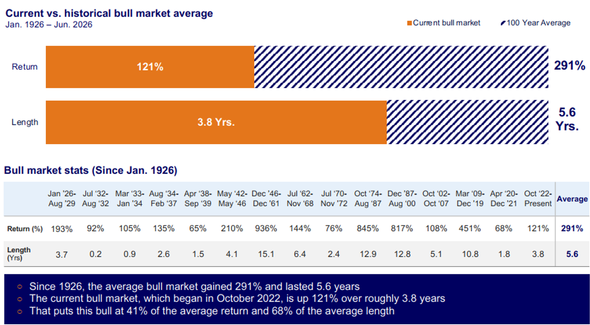
Source: Russell Investments, June 30, 2026
If history holds true, the current bull market will come to an end at some point. However, current underlying market dynamics and fundamentals appear to be supportive.
Editor’s note: The weekly update returns in mid-August.
__________
IMPORTANT DISCLOSURES: All info contained herein is solely for general informational purposes. It does not take into account all the circumstances of each investor and is not to be construed as legal, accounting, investment, or other professional advice. The author(s) and publisher, accordingly, assume no liability whatsoever in connection with the use of this material or action taken in reliance thereon. All reasonable efforts have been made to ensure this material is correct at the time of publication. Copyright Indiana Trust Wealth Management 2026.