

Indiana Trust Wealth Management
Investment Advisory Services
by Clayton T. Bill, CFA
Vice President, Director of Investment Advisory Services
- The U.S. equity market, represented by the S&P 500 index, rose 0.9 % this week.
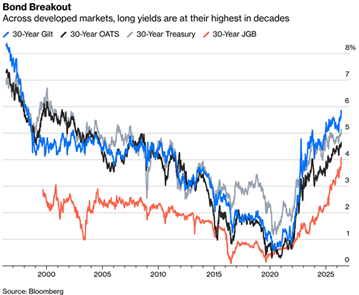
- Rising bond yields around the world have been shrugged off by stock markets in 2026.
The “doomer” side of the financial news cycle in recent weeks has focused upon rising long-term bond yields. In theory, rising long-term interest rates crimp borrowing for business investment, household consumption, housing, and durable goods. For equity market investors, higher yields on bonds negatively impact valuations (again, in theory), lowering stock prices.
To be sure, long-term bond yields are rising around the world. In the UK, for example, the 30-year Gilt yield is reaching levels previously seen before the turn of the millennium. Even Japan’s bond yields (JGB) are (finally) rising!
Fingers are pointing at rising energy prices. Central banks typically attempt to exclude energy from their inflation metrics when making interest rate policy decisions. However, high oil prices bleed through numerous indirect channels to impact price levels. Rising bond yields may be a signal that investors believe that central bank policy interest rate cuts have become less likely for the remainder of 2026.
So far, equity markets in the US and Europe have been mostly nonchalant in the face of higher bond yields. In the US, small company stocks have experienced a mild selloff, perhaps partly explained by the fact that small companies tend to use more floating rate debt to fund their businesses. The rise in US yields also applies pressure on emerging markets stocks, as George Pearkes at Bespoke noted this week. “Safe” US Treasury bonds become more attractive, leading to capital outflows from emerging economies.
Changes in interest rates can negatively affect the US stock market as a whole – but usually when rates move quickly up or down. The rate of change in the level of interest rates is what matters for the US market, because fast moves in interest rates tend to signify that something unexpected has occurred.
The US bond market has not experienced fast-moving bond yields this year. Interest rates appear to be bouncing around in a range, grinding along. It is not surprising that the US stock market has shrugged off the bond market’s recent weakness, for the most part.
__________
IMPORTANT DISCLOSURES: All info contained herein is solely for general informational purposes. It does not take into account all the circumstances of each investor and is not to be construed as legal, accounting, investment, or other professional advice. The author(s) and publisher, accordingly, assume no liability whatsoever in connection with the use of this material or action taken in reliance thereon. All reasonable efforts have been made to ensure this material is correct at the time of publication. Copyright Indiana Trust Wealth Management 2026.