

Indiana Trust Wealth Management
Investment Advisory Services
by Clayton T. Bill, CFA
Vice President, Director of Investment Advisory Services
- The U.S. equity market, represented by the S&P 500 index, rose 2.3% this week.
- Corporate earnings growth expectations are skyrocketing, driving stock prices higher.
The US stock market has been on a tear in recent weeks. One major driver pushing stocks higher is that equity analysts’ expectations for earnings growth are skyrocketing.
Typically, earnings growth estimates are gradually lowered throughout the calendar year as analysts update their projections with new information. BofA Global Research has calculated the historical average of negative revisions, reflected in the solid orange line in the chart below. This year, that orange line trend is being seriously bucked as expectations for 2026 (solid dark blue line) and 2027 (light blue line) are being revised sharply upward.
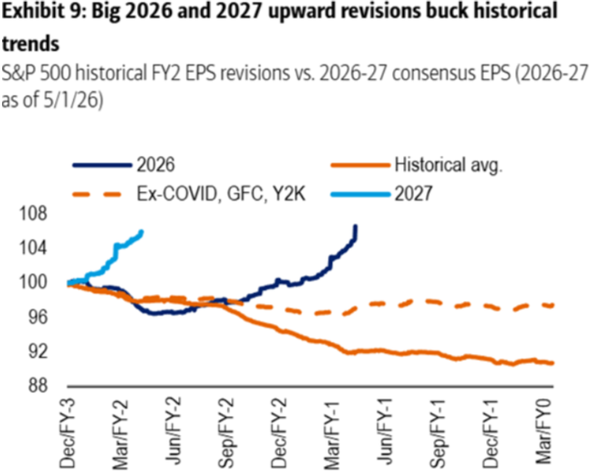
Source: BofA Global Research, May 2026
Investors care about future earnings growth. Theoretically, a company’s share price represents the present value of all future earnings the firm is expected to generate.
One straightforward way of formulating a stock’s price is the “dividend discount model”, a basic valuation tool that has been around for decades:

- The “P” is the price of the stock;
- The “D” is the dividend over the next year paid to shareholders from earnings (not all companies pay dividends, but that can be ignored for our purposes);
- The “r” is the cost of equity, or the investor’s required return (lengthy tomes have been authored about “r”, but that can be assumed to be constant, for now);
- The “g” is the expected growth rate of the dividends into the future.
All else equal, an increase in the “g” will lead to an increase in the “P” because the denominator is lower. The chart from BofA is a nice visual of the “g” dramatically rising.
Markets are more than math, but soaring earnings expectations are supportive of higher valuations.
__________
IMPORTANT DISCLOSURES: All info contained herein is solely for general informational purposes. It does not take into account all the circumstances of each investor and is not to be construed as legal, accounting, investment, or other professional advice. The author(s) and publisher, accordingly, assume no liability whatsoever in connection with the use of this material or action taken in reliance thereon. All reasonable efforts have been made to ensure this material is correct at the time of publication. Copyright Indiana Trust Wealth Management 2026.