

Indiana Trust Wealth Management
Investment Advisory Services
by Clayton T. Bill, CFA
Vice President, Director of Investment Advisory Services
- The U.S. equity market, represented by the S&P 500 index, rose 0.9% this week.
- Falling savings rates are widely viewed as negative economic developments. However, in the current period, they are a tailwind for corporate profits.
This week, the Bureau of Economic Analysis reported that Americans saved 3.6% of their disposable income in March. Paul Donovan at UBS noted that this figure has declined from 5.1% over the last year and a half, a noteworthy drop in the household savings rate.
On its face, this is a troubling development. Saving for the future is generally viewed as a virtuous activity, critical for our nation’s retirement health.
There is an underlying problem with this pro-savings worldview: one person’s spending is another person’s income. If everyone saved more, aggregate spending (or, in economist jargon, “demand”) would fall. In the medium term, everyone would be worse off, and the savings rate would ultimately fall.
This “paradox of thrift” was popularized by John Maynard Keynes 90 years ago, however it is an idea that stretches back to antiquity:
"There is that scattereth, and yet increaseth; and there is that withholdeth more than is meet, but it tendeth to poverty."
— Proverbs 11:24 (KJV)
From this perspective, the recent decline in the household savings rate means aggregate spending must have increased. At the macroeconomic level, a falling household savings rate is a source of corporate profits. The falling savings rate is one reason why S&P 500 profit margins are so historically strong and why corporate earnings growth expectations are rising, per the chart below:
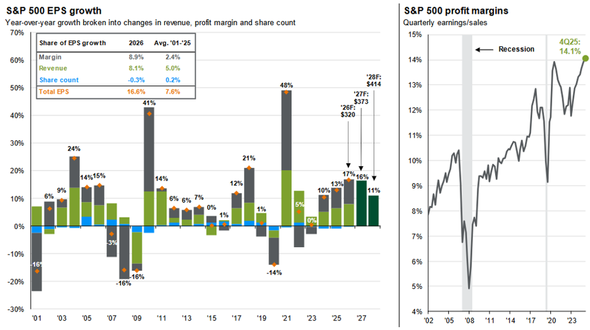
Source: JP Morgan Asset Management, as of 3/31/26
The other – more impactful – entity that is strongly dissaving is the US government. The federal budget deficit is always a hot political topic. However, macroeconomic accounting shows that the currently deep budget deficit, running at roughly 6% of GDP, is a massive source of corporate profits.
The resultant strong profit margins and rising earnings growth expectations partially explain why investors have generally shrugged off recent geopolitical “uncertainty”.
__________
IMPORTANT DISCLOSURES: All info contained herein is solely for general informational purposes. It does not take into account all the circumstances of each investor and is not to be construed as legal, accounting, investment, or other professional advice. The author(s) and publisher, accordingly, assume no liability whatsoever in connection with the use of this material or action taken in reliance thereon. All reasonable efforts have been made to ensure this material is correct at the time of publication. Copyright Indiana Trust Wealth Management 2026.