

Indiana Trust Wealth Management
Investment Advisory Services
by Clayton T. Bill, CFA
Vice President, Director of Investment Advisory Services
- The U.S. equity market, represented by the S&P 500 index, fell 2% this week.
- Headline CPI inflation has trended lower, while other measures of inflation – such as the PCE index series, favored by Fed officials – reflect a more complicated picture.
As measured by CPI, inflation peaked at 9% in the summer of 2022. As developments subsequently unfurled, including the fastest interest rate hike of magnitude in the modern history of the Federal Reserve, CPI inflation fell and now stands at 2.4%.
At first glance, given inflation’s downward trajectory, interest rates have room to fall in 2026. The Fed’s overnight target rate stands at 3.5%, and the market is pricing two 0.25% Fed cuts on deck for the coming year.
A somewhat wary tone has seeped into Fed officials’ comments and speeches in recent weeks. For example, Fed governor Stephen Miran has been the most vocal “dove” at the Fed since his appointment by President Trump in September, repeatedly calling for deep rate cuts and projecting the Fed’s target rate to end 2026 at 2.25%. He has walked back those ultra-dovish calls and now sees rates ending 2026 at 2.75% - still quite dovish, but not terribly far off market expectations.
Mr. Miran cited a resilient labor market as well as firming goods inflation for his changed outlook. Fed officials generally use the PCE index rather than CPI for inflation tracking, and Mr. Miran’s preferred inflation gauge is the esoteric “Market-Based Core PCE less Housing” metric. Omair Sharif of Inflation Insights notes that this measure printed 2.6% in January, its highest reading (apart from the pandemic) in over 30 years. It is 1% above its long-term average of 1.5%.
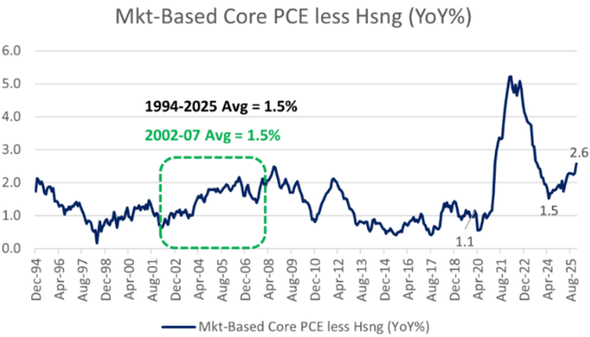
Source: Omair Sharif, February 20, 2026
Fed economists generally favor the Core PCE measure as it excludes energy prices, which can be extremely volatile. This week is a good example of why the Fed strips those prices out.
Even so, Core PCE is running at 3%, well above the Fed’s 2% target.
Inflation pressure has been building courtesy of AI-related spending by the major hyperscalers. The demands of the data center buildout have created real resource constraints, which are in the news with some frequency nowadays. A noteworthy example: the cost of dynamic memory chips (DRAM) is expected to rise 50% in the first quarter due to AI demand, according to Reuters, impacting the pricing and availability of several consumer products including smartphones and video game consoles.
While rate cuts are still very much on the table, there are a few risks to the path lower for interest rates lurking in the data watched by policymakers.
__________
IMPORTANT DISCLOSURES: All info contained herein is solely for general informational purposes. It does not take into account all the circumstances of each investor and is not to be construed as legal, accounting, investment, or other professional advice. The author(s) and publisher, accordingly, assume no liability whatsoever in connection with the use of this material or action taken in reliance thereon. All reasonable efforts have been made to ensure this material is correct at the time of publication. Copyright Indiana Trust Wealth Management 2026.