

Indiana Trust Wealth Management
Investment Advisory Services
by Clayton T. Bill, CFA
Vice President, Director of Investment Advisory Services
- The U.S. equity market, represented by the S&P 500 index, nudged 0.1% higher this week.
- Software stocks have been slammed over AI-replacement worries. Is it over for software stocks?
This week’s flat performance of the S&P 500 index masked a wide dispersion of returns across economic sectors. As Bloomberg’s Joe Weisenthal put it, for a few days it felt like any company not making canned soup was getting pummeled. Tech names, particularly the “software as a service” (SaaS) sector, suffered mightily.
The explanations offered boiled down to this: you can’t install an Anthropic AI plug-in on a can of cream of chicken soup. The concern is that advanced AI coding tools such as Anthropic’s Claude will make many SaaS companies obsolete - or any company that doesn’t make physical goods, for that matter.
A rotation from “growth” stocks, comprised mainly of tech names, to “value” stocks, which covers less exciting sectors such as banks, has been underway since last October. On Wednesday, value had its third best day versus growth going back decades, a historically huge day for value.
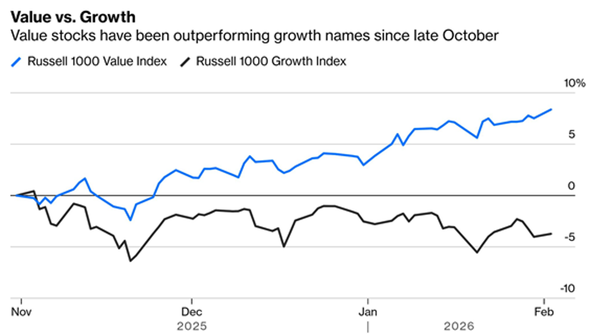
Source: Bloomberg, February 5, 2025
Names such as WD-40, maker of the ubiquitous lubricant, and Ball Corporation, the largest aluminum can manufacturer, are up over 25% year-to-date. An ETF tracking the software sector (IGV) is down 25%.
This is typical market price behavior. Jon Turek notes that stock prices and markets are not just outcomes – they represent a distribution of outcomes. If the chances of SaaS companies disappearing was previously zero but is now 5% - that is, the “left tail” of the “distribution” just went from zero to 5% - that can be a big deal in price terms.
While the ultimate outcomes across those distributions are unclear, some are declaring the existence of an AI bubble and that SaaS firms are doomed as if those are absolute facts. Those voices are also chattering about an impending AI-driven US economic recession because of these dynamics.
At a macroeconomic level, that narrative has gigantic holes. Big tech names are deploying over 2% of US GDP on capital expenditures, a massive sum. The federal budget deficit is over 6% of GDP. Private sector balance sheets are in fantastic shape (in the aggregate). Without an exogenous shock, a US recession seems unlikely.
__________
IMPORTANT DISCLOSURES: All info contained herein is solely for general informational purposes. It does not take into account all the circumstances of each investor and is not to be construed as legal, accounting, investment, or other professional advice. The author(s) and publisher, accordingly, assume no liability whatsoever in connection with the use of this material or action taken in reliance thereon. All reasonable efforts have been made to ensure this material is correct at the time of publication. Copyright Indiana Trust Wealth Management 2026.