

Indiana Trust Wealth Management
Investment Advisory Services
by Clayton T. Bill, CFA
Vice President, Director of Investment Advisory Services
- The U.S. equity market, represented by the S&P 500 index, slipped 0.4% for the week.
- Rising Japanese government bond yields may signify that the country is finally escaping its long economic stagnation, rather than other pernicious explanations for higher interest rates.
Stock markets around the world experienced a mild bout of volatility this week among various geopolitical concerns. Fingers were also pointed at the global bond market, specifically that of Japan. Japanese government bond yields have risen rather quickly in recent days, an unusual development.
Japan’s high ratio of national debt-to-GDP has been a source of consternation – or scaremongering – for years amongst market analysts. The recent explosion in Japanese bond yields has been trotted out as evidence confirming fears that Japan’s national debt is unsustainable. The narrative is that “bond vigilantes” are selling because of a lack of faith in Japan’s ability to service its debt. If true, risky asset classes such as equities would be negatively impacted.
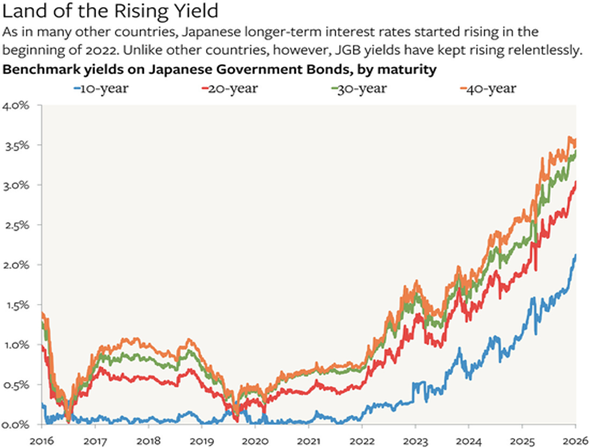
Source: Matthew Klein, January 12, 2026
Matthew Klein, an economist and author, argues for a more benign reason for rising Japanese bond yields: Japan is “normal” again. The Japanese government’s fiscal and monetary authorities have been trying for decades, mostly in vain, to escape from the economic malaise that has reigned since the bursting of its 1980’s-era asset bubble. There seemed to be no way out from the stagnation characterized by low investment, paltry wage growth, and low inflation. Massive budget deficits, interest rates at zero, and corporate governance reform did not do the trick.
Since the pandemic, however, hiring and investment have picked up, base salary growth is faster than in years past, and inflation expectations are higher. This is all exactly what Japanese officials have been hoping to achieve for a long time. Some confluence of factors has appeared to finally “reflate” Japan’s economy.
In this framework, higher interest rates are part and parcel of Japan’s escape from stagnation. Policy decisions on future short-term rates will be made by the Bank of Japan (and the Federal Reserve in the US) in response to growth, inflation, and employment. Those decisions influence long-term rates. It is no wonder that interest rates are higher now in Japan, and elsewhere.
__________
IMPORTANT DISCLOSURES: All info contained herein is solely for general informational purposes. It does not take into account all the circumstances of each investor and is not to be construed as legal, accounting, investment, or other professional advice. The author(s) and publisher, accordingly, assume no liability whatsoever in connection with the use of this material or action taken in reliance thereon. All reasonable efforts have been made to ensure this material is correct at the time of publication. Copyright Indiana Trust Wealth Management 2026.