

Indiana Trust Wealth Management
Investment Advisory Services
by Clayton T. Bill, CFA
Vice President, Director of Investment Advisory Services
- The U.S. equity market, represented by the S&P 500 index, rose 1.6% for the week.
- While employment overall is treading water, S&P 500 companies are increasing revenue per employee in a clear uptrend.
The US employment market can be best described as “bleh”. Labor conditions are not great, but they are not spiraling. Headline unemployment has dipped to 4.4%, placating those who feel everything is fine. Other data points are less encouraging, such as job openings. Excluding health care jobs, US payrolls have declined since October. Consumer sentiment surveys are generally terrible, continuing a multi-year trend.
Jan Hatzius, the chief economist at Goldman Sachs, believes that surveys, such as the consumer sentiment survey from the University of Michigan and the ISM business surveys, have lost market relevance. The “soft data” just does not help explain the economy or markets as well as they did 10 or 20 years ago. The “hard data”, such as jobless claims, has been a much better indicator.
To his point, despite these miserable consumer sentiment surveys, the economy has grown, and stocks have surged. One explanation for stock market strength during this period of tepid hiring and little firing is that S&P 500 companies have been able to increase inflation-adjusted revenue per employee.
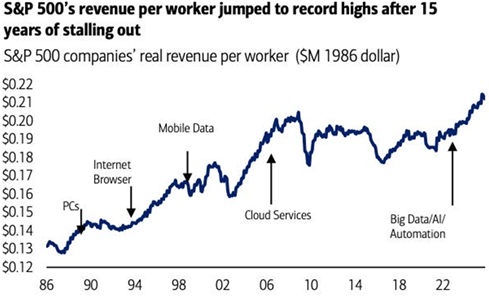
Source: Bank of America Global Research, Sam Ro, January 2026
How this is occurring is debatable. Are firms driving efficiency gains from AI? Without the need to hire and train new employees, are companies wringing more out of experienced employees - what the economist Tim Duy refers to as the “tenure dividend”? Are folks doing more from home?
Regardless, the S&P 500’s real revenue per worker is in a clear uptrend. This development is a straightforward positive for equities.
__________
IMPORTANT DISCLOSURES: All info contained herein is solely for general informational purposes. It does not take into account all the circumstances of each investor and is not to be construed as legal, accounting, investment, or other professional advice. The author(s) and publisher, accordingly, assume no liability whatsoever in connection with the use of this material or action taken in reliance thereon. All reasonable efforts have been made to ensure this material is correct at the time of publication. Copyright Indiana Trust Wealth Management 2026.