

Indiana Trust Wealth Management
Investment Advisory Services
by Clayton T. Bill, CFA
Vice President, Director of Investment Advisory Services
- The U.S. equity market, represented by the S&P 500 index, was off 2% for the week.
- Market narratives explaining recent volatility abound. One risk coming into focus is the next Federal Reserve interest rate decision in December.
US stocks are slumping and have had a choppy week. Bitcoin, viewed as a barometer for risk-taking and having a decent correlation with speculative tech stocks, is in the midst of its worst monthly drop in three years.
Market narratives are pointing to lofty valuations and concerns over whether AI investments will ultimately pay off. The stock market’s ethos, some claim, is moving from “take my money” to “show me”.
Other concerns could have triggered the market’s recent dip. The part of the Federal Reserve responsible for setting the Fed’s short-term interest rate target, the Federal Open Market Committee (FOMC), is set to meet in December. The public comments from the voting members of the FOMC in recent weeks reflect growing disagreement on what to do next.
Some members believe that the risks to the economy are tilted toward inflation, which requires interest rates to remain elevated. Inflation has run above the Fed’s 2% target for roughly the last five years. Members of the FOMC have voiced concern that the Fed may lose its “credibility” if it allows inflation to continue to run higher than its target. Coupled with recent political focus on affordability, this message may sound soothing to the public.
However, other members of the Fed believe that the risks for the economy lie in the stagnating labor market and rising unemployment, which need to be urgently addressed with lower rates.
Neil Dutta, an economist at Renaissance Macro, laid out the employment risks in a compelling note this week. Mr. Dutta is not buying the argument that employment is just fine and that slowing job growth is a benign function of immigration enforcement (i.e., fewer workers). If that were the case, he asks, why are job postings declining? Companies are not cutting job openings because of fewer immigrants. Rather, it implies a slowdown in labor demand. Also, underemployment is climbing. If a decline in immigration had an impact, underemployment would be steady. Instead, it has worryingly jumped this year.
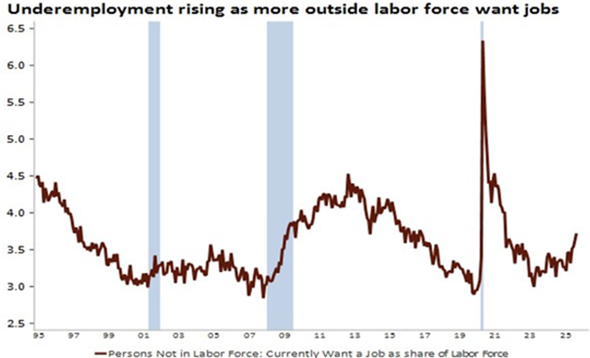
Source: Renaissance Macro Research, Bloomberg, November 19, 2025
Perhaps the market is sending the Fed a message. Recent volatility may reflect the rising risk that the Fed will choose to hold its overnight target interest rate steady at its next meeting. As Mr. Dutta points out, this is an important decision. If the Fed chooses to do nothing in December, it will likely do nothing in January as well. In his view, the Fed is too reactive and needs to cut rates to support the labor market.
There are other explanations floating around about recent market volatility. There may simply be too many investors over their skis with large leveraged positions, creating a sell-to-meet-margin-call loop. Just a typical washout, in other words.
Most tidy short-term market narratives should be written in pencil.
Editor’s note: the weekly note will resume in December. Indiana Trust wishes all its clients, community partners, and professional colleagues a wonderful, safe Thanksgiving!
__________
IMPORTANT DISCLOSURES: All info contained herein is solely for general informational purposes. It does not take into account all the circumstances of each investor and is not to be construed as legal, accounting, investment, or other professional advice. The author(s) and publisher, accordingly, assume no liability whatsoever in connection with the use of this material or action taken in reliance thereon. All reasonable efforts have been made to ensure this material is correct at the time of publication. Copyright Indiana Trust Wealth Management 2025.