

Indiana Trust Wealth Management
Investment Advisory Services
by Clayton T. Bill, CFA
Vice President, Director of Investment Advisory Services
- The U.S. equity market, represented by the S&P 500 index, rose 1.7% for the week.
- The Russell 2000 small-cap index had a strong third quarter, attributable to an explosion in so-called “concept stocks” in the US small-cap universe. There is considerable froth in those names.
The Russell 2000 index is the investment world’s US small-cap stock market index of choice, comprised, as its name would suggest, of the smallest 2,000 stocks by market value. As a result of many years of large-cap outperformance, the Russell 2000 now only represents 4% of the overall market. In the late 1990’s, small-caps were over 10% of the market. The small-cap universe has been shrinking.
The Russell 2000 had a strong third quarter, rising by over 12%, outpacing the S&P 500’s 8% return. The typical explanation for this is that small caps are more sensitive to interest rate fluctuations than large caps, as small companies have more floating rate debt on their books. Expectations for lower interest rates could help the outlook for small-cap profitability.
This story has a kernel of truth to it, but there is another factor propelling the Russell 2000 index more recently: investors piling into unprofitable, speculative quantum computing names such as Rigetti and IonQ, as well as non-revenue generating energy firms. These stocks now dominate the top end of the Russell 2000. The five largest names in the small-cap index are below:
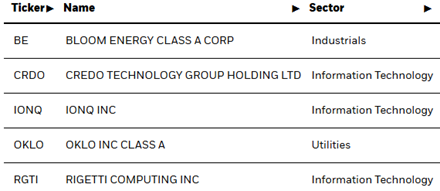
Source: Blackrock, October 17, 2025
IonQ, a quantum computing firm with a market capitalization of $22 billion, expects to be profitable in 2030. Oklo is a Sam Altman-backed modular nuclear reactor company which generates no revenue. It is the biggest US company that generated zero revenue over the last 12 months, and it is not expected to do so until 2028.[1] Oklo shares are up 800% this year and carry a market cap of $26 billion.
Mega-cap technology companies – Microsoft, Oracle, Meta, Google, and so on – dominate the S&P 500 index. The top ten companies in the S&P comprise 40% of its market cap. Those ten companies also generate 30% of the S&P 500’s total earnings, and they are growing.
The Russell 2000 index has rapidly become a haunted doppelganger of the large-cap S&P 500. Both indexes are dominated by tech firms at the top – except in the case of the Russell 2000, those firms are unprofitable, speculative, and non-revenue-generating “concept” stocks.
Despite all the talking heads calling a “bubble” for the S&P 500, it could be that the Russell 2000, where these concept stocks have exploded, is where there is considerable “bubble” risk. Notably, most active small-cap mutual fund managers have excluded these names, so far. Given their fundamentals, it is not difficult to see why.
[1] “The Frothiest AI Bubble Is in Energy Stocks” by Jinjoo Lee, The Wall Street Journal, October 15, 2025