

Indiana Trust Wealth Management
Investment Advisory Services
by Clayton T. Bill, CFA
Vice President, Director of Investment Advisory Services
- The U.S. equity market, represented by the S&P 500 index, was flat for the week.
- For obscure reasons, the US stock market typically exhibits some seasonal weakness in September – and particularly the first week of September.
As the calendar turns to September every year, temperatures begin to fall, kids go back to school, Chicago Bears fans begin to slowly lose hope, and US stocks exhibit uncanny weakness. This mysterious stock market behavior is referred to as “seasonality”.
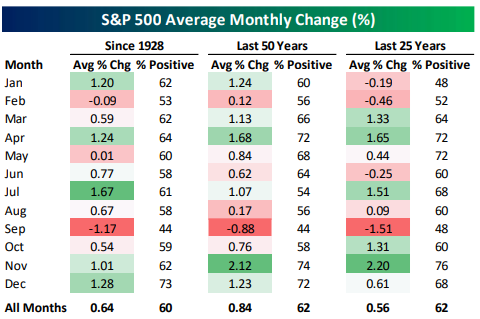
Per Bespoke Investment Group, since 1928, the S&P 500’s average monthly change during the calendar month of September has been a decline of 1.17% with gains just 44% of the time. The only other month in which the S&P 500 has averaged a loss is February (barely negative at -0.09%), and no other month has been negative more than half of the time.
Similarly, over the last 50 years, September is the only month that the market has averaged a decline, and its frequency of gains is the weakest of any month. Over the last 25 years, four calendar months have averaged declines, but September has easily been the weakest with an average decline of 1.51%.
Source: Bespoke Investment Group, August 29, 2025
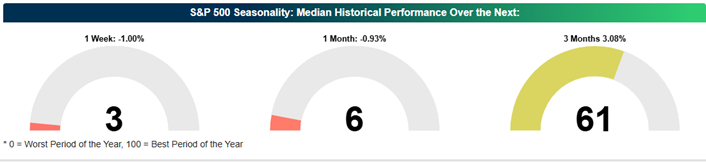
Also, per Bespoke’s seasonality model, the first week of September has specifically been amongst the worst one-week periods of the calendar year.
 Source: Bespoke Investment Group, September 2, 2025
Why has September been such a bad month for stocks? Some of the data is skewed by particularly bad markets in September 2008, during the Great Financial Crisis, but excluding that data still shows weak performance. Narratives to explain this seasonality (portfolio rebalancing prior to year-end, investors taking profits, tax management) are vague and unsatisfying.
Once investors brave the September doldrums, the seasonal headwinds become tailwinds. Over the last 25 years, October has averaged a gain of 1.31% and November has been the best month of the year. November is also the best month of the year over the last 50 years (2.12%), and it follows an average gain of 0.76% in October, as well.
Trying to sidestep the market in September does not make much sense. Despite its record of weak market returns, over the last 25 years, September has been positive 49% of the time. The best course of action is to stay invested and wait for seasonality – whatever is driving it – to pass.
__________
IMPORTANT DISCLOSURES: All info contained herein is solely for general informational purposes. It does not take into account all the circumstances of each investor and is not to be construed as legal, accounting, investment, or other professional advice. The author(s) and publisher, accordingly, assume no liability whatsoever in connection with the use of this material or action taken in reliance thereon. All reasonable efforts have been made to ensure this material is correct at the time of publication. Copyright Indiana Trust Wealth Management 2025.