

Indiana Trust Wealth Management
Investment Advisory Services
by Clayton T. Bill, CFA
Vice President, Director of Investment Advisory Services
- The U.S. equity market, represented by the S&P 500 index, rose 3.4% for the week.
- Lofty US stock market valuations are the result of the largest stocks in the market generating stronger earnings and revenue growth than smaller stocks, an unusual situation with little precedence.
The US stock market has recovered from its bout of volatility back in April and is close to its high point reached in mid-February. Over the last four months, stocks with the highest market capitalizations, as well as high price-to-sales and price-to-book ratios, have led the market’s rebound. Put another way: big, expensive stocks have been winning, once again.
The market’s price-to-earnings ratio (P/E), gauged by expected next-twelve-month earnings, is high relative to history. After steadily climbing post-2008, stock market valuations soared in 2019 and 2020, and those valuations have persisted. Investors counting on mean-reversion to historical P/E levels over the last five years are still waiting for that reversion to occur.
There is a twist to the market’s elevated valuation. While the market cap-weighted S&P 500 (where big market cap names such as Apple and Microsoft have higher weights) has a lofty valuation attached, the equal-weighted S&P 500 (where each of the 500 stocks in the index has an equal weight) does not. The equal-weighted index (the light blue line on the chart below) has the same P/E now as it did ten years ago:
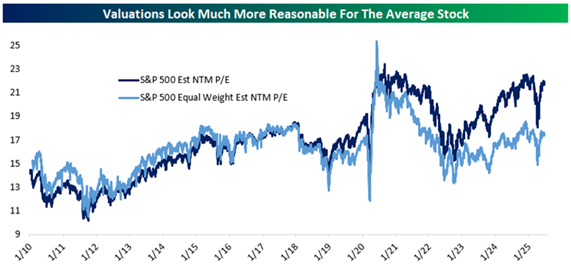
Source: Bespoke Investment Group, June 2025
The reason for this divergence? The largest stocks by market value have higher valuations than small stocks due to the big stocks’ remarkable ability to drive strong earnings and revenue growth. Big companies are growing faster than small companies, and the result is a higher market cap-weighted valuation. However, the average stock in the market does not appear extended relative to history.
Allocations to small-cap stocks provide exposure to different economic and market factors than large caps, which helps overall portfolio diversification. While mega-cap stocks have been winners over small stocks in recent years, market leadership can rotate quickly.
__________
IMPORTANT DISCLOSURES: All info contained herein is solely for general informational purposes. It does not take into account all the circumstances of each investor and is not to be construed as legal, accounting, investment, or other professional advice. The author(s) and publisher, accordingly, assume no liability whatsoever in connection with the use of this material or action taken in reliance thereon. All reasonable efforts have been made to ensure this material is correct at the time of publication. Copyright Indiana Trust Wealth Management 2025.