

Indiana Trust Wealth Management
Investment Advisory Services
by Clayton T. Bill, CFA
Vice President, Director of Investment Advisory Services
- The U.S. equity market, represented by the S&P 500 index, rose 1.5% for the week.
- Long-term interest rates are near multi-decade highs. This is not necessarily a problem for the stock market.
Long-term interest rates have increased over the last three years. It is commonly posited that rising rates hurt the stock market, for two reasons. First, higher interest rates make borrowing more expensive, which is bad for consumer spending and business investment. Second, they raise the cost of waiting for future corporate profits (or “free cash flows”) accruing to stockholders. Those cashflows stretch out decades into the future, and higher interest rates reduces their present values and thus should lower stock prices.
Unfortunately, one must attach “all else equal” to these statements. Equity investors are mainly concerned with corporate earnings and the prospects for earnings growth. There are other macroeconomic variables, such as the household savings rate and the federal government deficit, which can overwhelm the impact of higher interest rates on corporate profits.
A neat chart from Goldman Sachs via markets commentator Sam Ro shows the median annual returns of the S&P 500 back to 1940 across various interest rate environments. Even during periods of high interest rates, the stock market has had strong years.
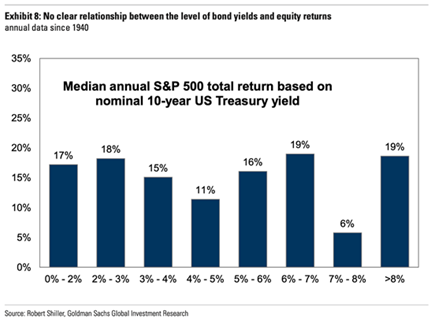
The Federal Reserve’s interest rate hiking campaign in 2022 is the main reason why long-term rates reached multi-decade highs in 2023 and have since stayed in that range. However, should the Fed begin to cut rates, it is not a certainty that long-term rates will decline. Perhaps long-term rates are reflecting a normalization, a departure from their long slide down stretching back to the mid-1980’s. If so, it does not necessarily mean that stocks will suffer from here.
Editor’s note: The weekly update will be on a brief hiatus and will return in late June.
__________
IMPORTANT DISCLOSURES: All info contained herein is solely for general informational purposes. It does not take into account all the circumstances of each investor and is not to be construed as legal, accounting, investment, or other professional advice. The author(s) and publisher, accordingly, assume no liability whatsoever in connection with the use of this material or action taken in reliance thereon. All reasonable efforts have been made to ensure this material is correct at the time of publication. Copyright Indiana Trust Wealth Management 2025.