

Indiana Trust Wealth Management
Investment Advisory Services
by Clayton T. Bill, CFA
Vice President, Director of Investment Advisory Services
- The U.S. equity market, represented by the S&P 500 index, rose 1.9% for the week.
- Around the world, long-term bond yields have risen. While they look attractive, investors should consider the interest rate risk associated with long-term bonds.
Yields on long-term bonds, those maturing in twenty or more years, have caught the attention of a swath of investors interested in locking in a steady stream of income. Currently, the 30-year US Treasury bond yield is 5%.
The main risk associated with US Treasury bonds is interest rate risk. While most bonds have a stated coupon interest rate that does not change, bonds are marketable securities. When market interest rates rise, the market prices of existing bonds fall so that they yield the new market interest rate. This risk can be quantified by a bond’s “duration”, which is a measure of a bond’s sensitivity to changes in interest rates. The longer a bond’s maturity, the higher its duration and the greater the interest rate risk. For example, should interest rates rise by 1%, the price of a bond with a duration of 10 would drop 10%. Even small changes in interest rates can make an outsized impact on bond prices.
While yields on long-term Treasury bonds look chunky relative to recent history, it is worth considering what would occur should interest rates rise. The iShares 20+ Year Treasury ETF maintains constant exposure to US Treasury bonds with maturities over 20 years. It has a duration of 15. A $100,000 investment in the ETF would be worth $85,000 should interest rates rise by 1%.
Rising long-term interest rates are a current issue for long-term bond investors around the world. Matthew Klein noted this week that due to rising yields in Japan, someone who had bought a new 40-year Japanese government bond in April 2024, when the yield was 2%, is now sitting on an unrealized price loss of more than 30%.
The duration of long-term bonds greatly amplifies the volatility of their total returns. Interestingly, the volatility of total returns on the iShares 20+ Year Treasury ETF over the last twenty years is very similar to the volatility of returns of the US stock market, as measured by their standard deviation of annual returns over that timeframe:
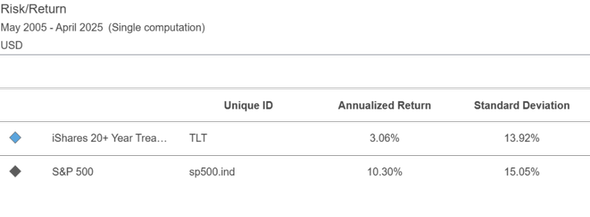
Source: Zephyr, Indiana Trust Wealth Management, May 2025
A long-term US Treasury bond does provide certainty of return of principal at maturity. For those who have certainty of their ability to hold a bond for twenty or thirty years, the market price fluctuations may not be a major concern. However, should those positions be needed for anything else – for gifting, for spending needs, for collateral on a loan – then the bond price matters.
__________
IMPORTANT DISCLOSURES: All info contained herein is solely for general informational purposes. It does not take into account all the circumstances of each investor and is not to be construed as legal, accounting, investment, or other professional advice. The author(s) and publisher, accordingly, assume no liability whatsoever in connection with the use of this material or action taken in reliance thereon. All reasonable efforts have been made to ensure this material is correct at the time of publication. Copyright Indiana Trust Wealth Management 2025.